It All Started Here
How the places I escaped to became the landscape of Book of David...

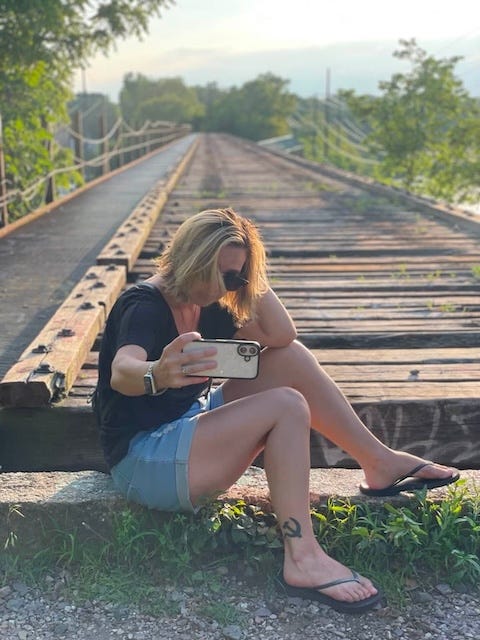
I’m chilling in my office in the middle of a heatwave and checking out old pictures from my hipster years that I feel portray “Midwest Rot” while listening to Role Model. I can’t explain why this feels so right, but it does. I just finished rereading Bipolar Cowboy by Noah Cicero for like the 11th time. My mind is in the exact headspace I need it to be for this kind of retrospection. Like all hunts for past memories, it began on facebook where I found a photo album that’s “private” because it’s so cringe. It’s named “St. Charles-Autumn.” In it, you can see me in my RayBans and black American Apparel hoodie walking around one of my favorite Midwest towns with my future husband. My favorite pictures are of the abandoned railroad bridge that we would hang out at for no reason. Perhaps we were feeling adrenaline because we weren’t supposed to be there or did it for irony’s sake because it looks like that one scene from Stand By Me. Neither would surprise me and for that and several other cringe reasons, that entire album will remain “private” on Facebook.
The rusted iron bridge across the Fox River didn’t feel historic when I was twenty. It was just a dead stretch of the Chicago Great Western railway that cut through the trees above the water and looked almost post-apocalyptic. With overgrown plants sprouting beneath the tracks, it looked like civilization didn’t exist up there.
I spent an embarrassing amount of time up on that bridge.
There was no reason to choose that specific bridge over any other crossing in Kane County, except that it was hidden. You had to know the exact break in the treeline behind the bike path near the weird statue of a Fox made out of old bicycles to even find the embankment. The eerie iron rails sat directly above the concrete bike path bridge, meaning you were entirely visible to the cops or anyone else passing below if they bothered to look up. But nobody ever really did. Or everyone did and just didn’t care except for the cop that one time busted me when I was 23. Not sure he even gave af other than he was just doing his job. He stopped us on our way up so I’m not entirely sure if that circumstance even counts.
Regardless of that, there was something much more romantic about the railroad bridge above the bike path above the Fox River than any other abandoned rail road I’d been to. It belonged to the brush and the heat and nothing else. It smelled like rusted flaking metal, stale river water with a hint of sewage, and the sharp, chemical tang of tar baking under a Midwest September sun.
We would climb up the gravel behind the trees, sliding backward and grabbing branches or leftover beer cans in the dirt to stabilize ourselves. In typical Mallory fashion, I always either wore flip-flops or a pair of loose Chuck Taylors without socks. Once, my foot caught a loose patch of rocks on the way up. My balance went right, my weight shifted toward the drop, and for a half-second, I looked straight down at the steep, jagged incline of the embankment. My boyfriend (the person who would eventually become my husband) grabbed the hood of my American Apparel zip-up and yanked me forward onto the flat ridge.
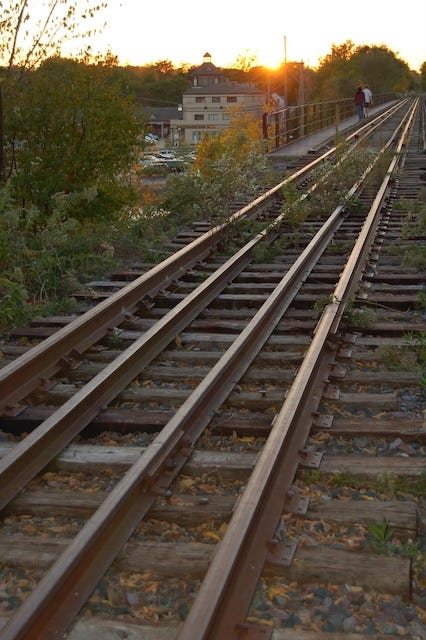
We never talked about it. I just said that didn’t happen and walked out onto the wooden beams thankful that no one could see you climbing up to the rail road. Just that you were randomly there. Like you had manifested yourself onto the bridge out of sheer angst and a death wish. I sat down right on the metal framework looking at the river, my heart slamming against my ribs, and lit a Natural American Spirit because David Lynch smoked them. I seriously have the worst reasons for doing the majority of the things I do. You wouldn’t know it, but my hands wouldn’t stop shaking for what felt like an hour.
We didn’t go back down right away. You don’t go through that just for a quick visit. We stayed for closer to three hours. That was a rule in my mind: you didn’t let the place scare you off, because if you went back to the car with no pictures to show your sense of YOLO, you had to face the reality of what time it was.
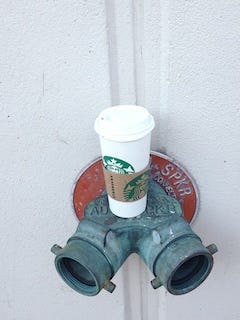
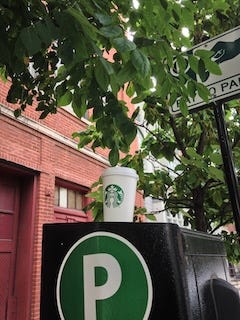
I carried a light, Pentax K1000 that forced you to think about exposure before you clicked it. Around that time I became obsessed with photographing abandoned Starbucks cups. Not filled with coffee. Not at the actual shops. Just the cups people left behind in parking lots or wedged onto fence spikes that held back bushes or balanced on guardrails. They were everywhere except the trash can they were designed for. I even did a weird entire photo series of them with ridiculous captions that were my attempts at looking serious and profound during the alt lit era. Looking back, I wasn’t snapping pictures of trash. I was photographing evidence that someone had just been there.
We talked for hours up there, but it wasn’t about books or art. It was always about leaving Illinois. Every conversation, no matter how it started, eventually looped back to the Lincoln Highway, the airport, or train schedules. Somewhere along the way we’d convinced ourselves that if we moved to San Francisco, or Portland, or New York, or maybe even Istanbul where part of his family still lived, our lives would finally begin.
I don’t remember feeling trapped on that bridge though. If anything, I remember feeling unusually still and at peace. I typically attribute it to the river below because I have a thing for rivers even though I can’t swim. But there was something more about the sense of abandonment up there. We’d spend hours talking about getting out of the Midwest while sitting in the one place that made me feel most at peace.
He would look down at my feet like clockwork and note that I was either wearing fli flops or my Chuck Taylors with no socks and mock me. Say I had absolutely no sense of self-preservation.
But I’d always come back with the fact that I’d never fallen.
In hindsight, it wasn’t the argument I thought it was.
On our tenth anniversary, we stood at the base of that same approach and couldn’t believe we used to do that. The recklessness of our early 20’s before our prefrontal lobes had fully developed looked like a major head injury or death on impact from a decade’s distance.
Weeks ago, I returned again to film some promotional footage for Book of David which is coming out in October from House of Vlad.
The tracks themselves were gone.
The wooden beams had been ripped up and the iron rails ripped away. Only a flat, gravelly path remained. The metal bridge structure was still hovering over the river above the bike path, but the connection had been severed.
That’s the thing about the Midwest. It doesn’t ruin beautifully. It doesn’t leave grand, ominous skeletons like the ghost towns out South West that Scott Laudati sent me pictures of months ago or the crumbling stone structures back East. Here, erasure is efficient. The iron that was now gone had been laid down across the Fox River in the late 1880s, back when steam engines hauled freight into Chicago. I think I wrote another essay here on Substack explaining why rail roads like this were the beating heart of the Midwest and the only way it was able to thrive. This specific one ran through the world for nearly a hundred years before the company finally walked away from the line in the late 70’s. By the time we were sitting on it, the bridge had already spent a couple of decades lifeless. A century-old skeleton just hovering over the river below.
Then one day a village or municipality buys a right-of-way. Likely because the once quaint town became gentrified and filled with yuppies who occupied newly built breweries and luxury condos down the way.
In such situations, standard Chicago bureaucracy that would typically take years to finish, would take days. A construction crew shows up on a Tuesday morning with tools I don’t have names for. By Thursday morning, all of it is replaced by a stripped-up, barren gravel path with metal guardrails over the water. It’s an aggressive kind of tidiness. It removes the evidence before you can even figure out what it meant to you. The land has no memory once capitalism becomes involved. The iron doesn’t wait around to become a literary landmark. It waits for the scrap yard and derivative sculptures from salvaged parts that it might be used for one day.
But if the land has no memory, the brain becomes a problem. Because I still remember the smells of the hot tar and rusted metal below. The actual rails are likely positing to be melted down into rebar for a new strip mall in Naperville, but their coordinates haven’t cleared out of my mind.
As the new Role Model Song, Joy, comes on, I start thinking about the other places I used to go when I was trying to disappear. I went to the bridge mostly in the early summer or fall, when the transition between seasons made the waiting feel almost productive.
After therapy, I’d walk to the Fox River and wait for my dad to pick me up. Sometimes I’d sit on one of the floating docks. The ebbs and flow somehow caused my anxiety to wash away. They don’t exist anymore either. The docks, not my anxiety. Other days I’d climb the embankment and wander out onto the railroad bridge and challenge my mental health instead. The river never asked how therapy went or what I took away from last week’s session. It didn’t ask if I was finally fixed. It just kept moving, and for whatever reason, that was enough.
I’d go to empty Target parking lots after midnight, sitting right on the concrete curbs under the flat, crappy fluorescent lights that were still on for some reason and did nothing but listened to the ring ting sound of cicadas and the occasional rumble of tires from cars passing on busy road nearby.
Later, when I could finally drive, the walks turned into aimless trips toward Wisconsin. I’d cross the state line for no reason other than I could. My husband and I would quote Into the Wild: “we’re going nowhere.” We’d stop at gas stations I’d never see again just to hear whatever strange music happened to be coming through the crackling speakers near the pumps. I’d buy a can of Arnold Palmer or Peace Tea because they somehow felt like the correct drinks for driving toward nowhere in Wisconsin after midnight.
There was one little station outside Lake Geneva that always seemed to be playing REO Speedwagon through blown out speakers. The gas station itself was old and faded and looked like it came out of an Instagram collection of haunted places. The cashier had a faded shamrock tattoo that made me think of my sister and barely spoke. I’d sit in the car, listening to the brass fight with the buzz of the overhead lights, wondering why somewhere so forgettable felt impossible to forget.
The Belvidere Oasis was another one of those places. A glass-and-steel cathedral where you could buy some McDonalds and look through the glass surroundings at semi-trucks passing directly below you at seventy miles an hour. It’s one of the few left standing after some great Oasis Purge a few years ago. I’d like to think that it was spared because of some divine intervention or special status it held above the others but even the Des Plaines Oasis didn’t survive and it was iconically fucked up by Carrie Fisher with a flamethrower in Blues Brothers.
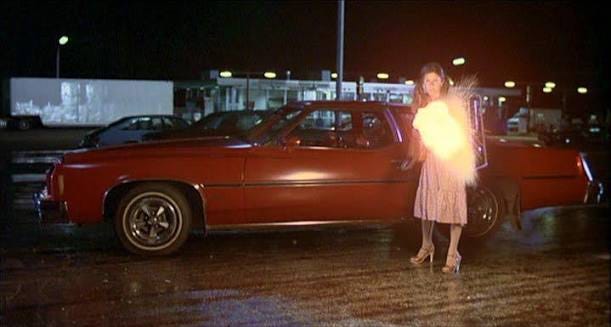
Nothing sacred remains.
So why do I remember the hum of a Wisconsin gas station more vividly than the 5 apartments I lived in? Why can I still sense the payphone bank at the Belvidere Oasis, but not the classrooms I was stuck in during high school? Why the fuck did I spend an entire year photographing abandoned Starbucks cups but never thought to photograph the deck in the back of the house where I grew up?
I have no good answer.
A gravel ridge overrun with brush and old beer cans where the tracks used to be doesn’t have a job anymore. Parking lots, train tracks, suburban curbs after midnight. They’re all zones where the rules of a space where people live don’t quite apply because everyone is either leaving or waiting to leave.
Maybe memory was never the land’s job. Maybe that’s why I kept photographing what everyone abandoned instead of people themselves.
As I finish listening to Joy for the 3rd time, I realize I always seem to write about what it feels like to wait so long for your life to begin that you stop noticing you’re waiting for something that’s already in motion.
I didn’t know that’s what I was writing until Book of David was finished.
I watched the river for a while before climbing back down.
There wasn’t any reason to stay.
There hadn’t been one back then either.
Book of David is available for preorder now from House of Vlad:
https://houseofvlad.bigcartel.com/product/book-of-david-stories-by-mallory-smart-signed-pre-order